Thursday, 5 February 2015

Content Strategy for the Web: 3 Tips from HubSpot to Grow Your Content Audience

Two grad-school friends, one brilliant idea, and overflowing showers of success. Who doesn’t love an inspirational startup story of two underdogs succeeding?

content marketing strategy for the web picture of hubspot's office entrance  

Image via Flickr

For me, HubSpot’s story has always hit close to home, since Brian Halligan and Dharmesh Shah grew their business out of my (and WordStream’s) close neighbor, Cambridge, MA. Meeting at MIT and identifying that marketing tactics are no longer working since the world has changed, they developed HubSpot, which is now a publically traded company (they IPO’d in October of 2014). HubSpot built itself off of the notion that instead of having sales people harass their prospects and shove their brands in peoples’ faces, marketers instead need to focus on “sharing relevant information, creating useful content, and generally being helpful.” This notion is known as “Inbound Marketing,” which HubSpot has spurred a revolution around.

“The inbound experience is about attracting, not interrupting; it’s about helping not harassing. It’s an empathetic approach to growing a business because at the end of the day it’s not just the potential purchaser on the other end, it’s an actual person,” says HubSpot co-founder, Dharmesh Shah.

In Dharmesh’s MIT days he started a blog called OnStartups, which gained a massive readership. Dharmesh and Halligan were both stumped of how a tiny blog written by a young college kid could gain so much ground. With no budget behind the blog both were in awe, but this spurred them to think about marketing in a whole new way.

Alright, enough about this heart-wrenching startup story, let’s talk about HubSpot’s current blog, which has roughly 2 million monthly readers.

Recently I was able to connect with Joe Chernov, the Vice President of Content at HubSpot, who shed some light on the content strategies used to grow HubSpot’s blog following and become viewed as a thought-leader in the industry. From Joe’s insight, I’ve come up with three guiding principles that you can apply to your content strategy to grow your readership and produce higher quality content.

Be Honest & Transparent

Joe explained that transparency is critical in gaining a quality reader base on HubSpot’s blog. “We are honest about who we are and what we do,” says Joe. “We don’t pretend we aren’t a software company. I believe honestly enhances our credibility.”

But software is not sexy. Aren’t content marketers supposed to make their brand appear attractive and intriguing to their followers? Well, yes, but if you are not clear about who you are then prospects are going to stay prospects and you could risk bringing the wrong audience to your content. “Content marketers are prone to say, ‘Help, don’t sell,’” says Joe. “Though correct, the axiom shouldn’t preclude you from acknowledging, sometimes in the content you produce, what you do or what you sell. We’re comfortable toeing that line.”

content marketing strategy for the web cartoon  

Image via Flickr

Clearly, there needs to be a balance between creating content that is informative and educational and creating content that is self-promotional, but if you can do both at the same time then you have the best of both worlds. For example, let’s say you sell spiritual retreats; create a blog post that speaks to your target audience. What do they struggle with? What problems do they face? Perhaps you create a post on “10 Ways to Beat Stress and Improve Your Well-Being.” In this post provide useful information, but also bake in a subtle call-to-action to learn more about embarking on a spiritual retreat that has the potential to transform your well-being. This is a fictional example, but a strategy that several bloggers do well, and which I encourage you to implement in your own content strategy.

Organize Your Content to Cater to Each Audience

Do you offer multiple products? Or one product that serves multiple audiences? Here at WordStream, we have a clear distinction between advertisers (as in businesses that are advertising their own business on AdWords and Bing) and marketing agencies (agencies which help their clients advertise). We market, sell, and service these two audiences in different ways. Why? Because they have different needs and goals and respond to different content. For example an advertising agency is typically more concerned with workflow and time-savings since they’re managing multiple client accounts, as opposed to an advertiser who is focused solely on growing their own business.

HubSpot has split up their blog to speak to their various audiences. “We serve three separate audiences – marketing, sales and agency professionals,” says Joe. “Each has unique interests, so rather than a single blog that co-mingles disparate topics, we separate them by persona to maximize the signal and minimize the noise.”

content strategy for the web screenshot of hubspot's blog 

This strategy has proven successful for HubSpot since they’ve really grasped and tested the content that works best for each audience, but I’m not necessarily suggesting you segment your blog by channel. First build your audience, figure out if different content resonates with different personas and then re-fine from there.

Create a “Culture of Content”

I won’t name names, but I can vividly remember a college internship I completed that had a company culture that was a bit, well…depressing. The office was infused with headache inducing florescent lighting, the employees all trumped 50+ (nothing against the older generation, but for a 20-something college student the lack of youth can be discouraging at times), and having a colleague ask you what LinkedIn or Facebook was, was not out-of the norm.

Going forward, a vibrant and youthful culture was a must-have on the checklist of future employment options. HubSpot has always been huge on company culture and for good reason! Establishing a lively, fun, and transparent environment should be a priority for every business. I know WordStream has been beyond successful with this, but what exactly is meant by a culture of content? Similar to what I’m sure you are imagining, it’s the idea of engaging employees to participate in the content production of your company.

content strategy for the web picture of wordstream employees on halloween 

WordStream employees enjoying our company culture on Halloween

“There’s absolutely a ‘culture of content’ at HubSpot,” says Joe. “We enjoy contributions from HubSpotters in all departments and at all levels. We also have the luxury of great partners, who also contribute fresh, original content to our blog.”

But not everyone wants to or has time to blog. So what can you do to create a “culture of content?” Start by…

  • Creating an Engaging Company Culture: First make sure your employees are truly happy! They won’t want to contribute to creating content if they are generally unhappy in the culture of your office environment. Plan happy hours, group events, provide snacks and drinks in your office, and let you employees know how much you appreciate all they do on a regular basis. HubSpot provides endless snacks, happy hours, team outings, and company events to keep their employees smiling.
  • Publicize Call-To-Actions to get Employees Involved in Content Production: Make it clear that you want your employees to get involved! Whether that be through regular company emails highlighting the benefits of contributing (i.e. build your personal brand, establish credibility to your prospects and leads, etc.) or attending various department meetings and presenting the goal of more content from employees.
  • Help Ease the Pain of Creating Content: An engineer or sales person likely does not have the advanced content creating ability that someone in marketing does. Help them! Create blog post templates that can assist them in outlining and crafting a post, conduct writing workshops to help improve employees skill sets, and have brainstorming sessions to help employees come up with content ideas.
  • Provide Incentive: Who doesn’t love a steak from Capital Grill? Or a vegetarian feast from a local eatery? Create a rewards program for the top contributors to encourage their participation. At WordStream we offer a $100 gift card to the employee (outside of marketing) whose blog post performs the best during the month. For employees that contribute three posts per quarter we plan a team outing; for example, we recently attended a Bruins Game at TD Garden. Adding a “fun” element to creating content is an easy way to get valuable insight from employees in every department.

Have you used any of HubSpot’s superbly successful content strategies in your marketing efforts?

If so, have you seen them to be successful?

About the Author:

Margot is a Content Marketing Specialist at WordStream with a background in PPC, SEM, content and digital marketing. She enjoys running and eating ice cream during her free time (not simultaneous although that would be impressive). Follow her on:

Twitter: @ChappyMargot

Google+: +Margot da Cunha

LinkedIn: http://www.linkedin.com/pub/margot-da-cunha/30/3a7/14b

WordStream Visibility:
Display in WordStream Blog
WordStream Blog Tags Vocabulary:
Social Media Share:

Wednesday, 4 February 2015

How to Prevent Hackers from Using Bad Bots To Exploit Your Website

Posted by brianhughes

Googlebots-2.png

(Image created by the author)

The Bot Bandits Are Out of Control

I’ve always known that bots crawl my websites and the sites of all my fellow developers, but I was unaware that bots now make more visits than people do to most websites. Yep, they officially overtook us in 2012, and bots now dominate website visits. Egad, it’s Star Wars run amok!

Before we become alarmed, though, let’s look at a few facts that demonstrate the preponderance of bots in our midst.

The bots are coming. The bots are coming. The bots are here!

(Image source)

Incapsula’s 2013 bot traffic report states that “Bot visits are up 21% to represent 61.5% of all website traffic." If bots are preponderant, what does that mean for us?

For those of you just tuning in, preponderance means “the quality or fact of being greater in number, quantity, or importance.” That means the bots are “more important than humans” in determining the value of websites to potential readers.

A quick look at antonyms for preponderance reveals that our plight is worse than expected. Antonyms for preponderance include disadvantage, inferiority, subordination, subservience, surrender and weakness.

All is not lost, however. Not all bots are bad. In fact, in the wild and woolly world of SEO, Googlebots are actually our friends. A "Googlebot" is Google's web crawling bot, also known as a "spider," that crawls the Internet in search of new pages and websites to add to Google's index.

Googlebots: Our Ally in the Bot Wars

If we think of the web as an ever-growing library with no central filing system, we can understand exactly what a Googlebot wants. A Googlebot’s mission is to crawl this library and create a filing system. Bots need to be able to quickly and easily crawl sites. When a Googlebot arrives at your site, its first point of access is your site’s robot.txt file, which highlights the importance of ensuring it's easy for the bots to crawl your robots.txt file. The less time Googlebots spend on irrelevant portions of your site, the better. At the same time, be sure you have not inadvertently siloed or blocked pages of your site that should not be blocked.

web-crawler-s-cropped.jpg

(Image source)

Next, Googlebots use the sitemap.xml file to discover all areas of your site. The first rule of thumb is this: keep it simple. Googlebots do not crawl DHTML, Flash, Ajax nor JavaScript as well as they crawl HTML. Since Google has been less than forthcoming about how its bots crawl JavaScript and Ajax, avoid using this code for your site’s most important elements. Next, use internal linking to create a smart, logical structure that will help the bots efficiently crawl your site. To check the integrity of your internal linking structure, go to Google Webmaster Tools -> Search Traffic -> Internal Links. The top-linked pages should be your site’s most important pages. If they aren’t, you need to rethink your linking structure.

So, how do you know if the Googlebots are happy? You can analyze Googlebot’s performance on your site by checking for crawl errors. Simply go to Webmaster Tools -> Crawl and check the diagnostic report for potential site errors, URL errors, crawl stats, site maps and blocked URLs.

The Enemy in our Midst: Bandit Bots

Googlebots aren't the only bots visiting your site. In fact, over 38% of the bots crawling our sites are out for no good. So not only are we out-numbered, but nearly 2 out of every 5 visitors to your site are trying to steal information, exploit security loopholes and pretend to be something they are not. 

We'll call these evil bots "bandit bots".

So, what are we to do?

As an SEO provider and website developer, I could protest. I could blog my little heart out and get a few friends to join me. Or I could buckle down and take responsibility for my own little corner of the web and fight back against the bandit bots. 

Let's do this together.

Bandit Bots: What They Are and How to Fight Back

Terminator-Robot-dreamstime_s_34845625-C

(Image source)

The bad guys come in four flavors. Learn which bots to watch out for and how to fight back.

Scrapers

These bandit bots steal and duplicate content, as well as email addresses. Scraper bots normally focus on retrieving data from a specific website. They also try to collect personal information from directories or message boards. While scraper bots target a variety of different verticals, common industries include online directories, airlines, e-commerce sites and online property sites. Scraper bots will also use your content to intercept web traffic. Additionally, multiple pieces of scraped content can be scrambled together to make new content and allow them to avoid duplicate content penalties.

What’s at risk: Scrapers grab your RSS feed so they know when you publish content. However, if you don't know that your site is being attacked by scrapers, you may not realize there's a problem. In the eyes of Google, however, ignorance is no excuse. Your website could be hit by severe penalties for duplicate content and even fail to appear in search engine rankings.

How to fight back: Be proactive and attentive to your site, thus increasing the likelihood that you can take action before severe damage is done. 

There are two good ways to identify if your site is the victim of a scraper attack. One option is to use a duplicate-content detection service like Copyscape to see if any duplicate content comes up.

Copyscape-Plagiarism-Checker-Cropped-hig

(Image created by the author)

A second option for alerting you that content might have been stolen from your site is to use trackbacks within your own content. In general, it's good SEO to include one or two internal site links within your written content. When you include these links, be sure to activate WordPress's trackback feature. In the trackback field on your blog’s entry page, simply enter the URL of the article you are referencing. (In this case, it will be one on your own websites, not another site).

Add-New-Post-WordPress-cropped-highlight

Add-New-Post-WordPress-2-cropped-highlig

(Image created by the author)

You can manually look at your trackbacks to see what sites are using your links. If you find that your content has been re-posted without your permission on a spam site, file a DMCA-complaint with Google.

Finally, if you know the IP address from which scraper bots are operating, you can block them from your feed directly. Add the following code to your .htaccess files. Learn how to edit your .htaccess file. (See editing your .htaccess file on WordPress.)

RewriteEngine on
RewriteCond %{REMOTE_ADDR} ^69.16.226.12
RewriteRule ^(.*)$ http://newfeedurl.com/feed

In this example, 69.16.226.12= is the IP address you want to send to and http://newfeedurl.com/feed is the custom content you want to send them.

Warning! Be very careful editing this file. It could break your site if done incorrectly. If you are unsure of how to edit this file, ask for help from a web developer.

Hacking Tools

Hacking bandit bots target credit cards and other personal information by injecting or distributing malware to hijack a site or server. Hacker bots also try to deface sites and delete critical content.

What’s at risk: It goes without saying that should your site be the victim of a hacking bot, your customers could lose serious confidence in the security of your site for e-commerce transactions. 

How to fight back: Most of the attacked sites are victims of "drive-by hackings," which are site hackings done randomly and with little regard for the impacted business. To prevent your site from becoming a hacking victim, make a few basic modifications to your .htaccess file, which is typically found in the public_html directory. This is a great starter list of common hacking bots. Copy and paste this list into the .htaccess file to block any of these bots from accessing your site. You can add bots, remove bots and otherwise modify the list as necessary.

Spammers

Spam bots load sites with garbage to discourage legitimate visits, turn targeted sites into link farms and bait unsuspecting visitors with malware/phishing links. Spam bots also participate in high volume spamming in order to cause a website to be blacklisted in search results and destroy your brand’s online reputation.

What’s at risk: Failure to protect your site from spammers can cause your website to be blacklisted, destroying all your hard work at building a credible online presence. 

How to fight back: Real-time malicious traffic detection is critical to your site’s security, but most of us don't have the time to simply sit around and monitor our site's traffic patterns. The key is to automate this process.

If you're using WordPress, one of the first steps to fighting back against spam bots is to stop spam in the first place. Start by installing Akismet; it is on all my personal sites as well as the sites I manage for my client. Next, install a trusted security plugin and setup automatic backups of your database.

WordPress-Security-Plugins.png

(Image create by the author)

Require legitimate registration with CAPTCHAs for all visitors who want to make comments or replies. Finally, follow wordpress.org to learn what’s new in the world of security.

Click Frauders

Click fraud bots make PPC ads meaningless by “clicking” on the ads so many times you effectively spend your entire advertising budget, but receive no real clicks from interested customers. Not only do these attacks drain your ad budget, they also hurt your ad relevance score for whatever program you may be using. Google AdWords and Facebook ads are the most frequent targets of these attacks.

What’s at risk: Click fraud bots waste your ad budget with meaningless clicks and prevent interested customers from actually clicking on your ad. Worse, your Ad Relevance score will plummet, destroying your credibility and making it difficult to compete for quality customers in the future.

How to fight back: If your WordPress site is being targeted by click fraud bots, immediately download and install the Google AdSense Click Fraud monitoring plugin. The plugin counts all clicks on your ads. Should the clicks exceed a specified number, the IP address for the clicking bot (or human user) is blocked. The plugin also blocks a list of specific IP addresses.

AdSense-Click-Fraud.png

(Image created by the author)

When defending a website from hacker bots, it takes a concentrated effort to thwart their attacks. While the above steps are important and useful, there are some attacks, like coordinated DDoS, that you simply cannot fight off on your own. Fortunately, a number of tech security companies specialize in anti-DDoS tools and services. If you suspect your site (or one of your client’s sites) is being targeted for DDoS, such companies can be key to a successful defense.

I recommend following wordpress.org to learn what’s new in the world of security.

Summary

Giving honest Googlebots what they want is quite simple. Develop strong, relevant content and publish regularly. Combatting the fake Googlebots and other bot bandits is a bit tougher. Like many things in life, it requires diligence and hard work.


Sign up for The Moz Top 10, a semimonthly mailer updating you on the top ten hottest pieces of SEO news, tips, and rad links uncovered by the Moz team. Think of it as your exclusive digest of stuff you don't have time to hunt down but want to read!

Twitter Targets SMBs With A Way To Buy Promoted Tweets In Its Analytics Page

png;base64d28767cf1984dbd4 While Twitter expands Promoted Tweets to run on other websites and apps, the social network is also trying to boost usage of them (and revenue from them) on its own platform. Today, it’s announcing a new feature aimed at small and medium businesses it’s referring to as “quick promote“, which will let SMBs select their most popular Tweets and boost them directly… Read More
Tinder Tests Limited Right Swipes

Screenshot 2015-02-03 15.44.43 Tinder is looking at a way to swipe left on spam. The company released an update to the app that includes a beta feature for Tinder Plus called “Unlimited Likes”. Obviously, unlimited likes is already a free feature on Tinder, but the feature is only meant to be shown to spammers and bots. Read More

Tuesday, 3 February 2015

Hate this Headline? You’ll Probably Share the Story.

I spent a chunk o’ time messing with the headline above. See, I want a lot of people to read this blog post. Bloggers generally attach great value to the number of viewers a post earns. And a proven strategy for increasing the reach of your content is to inspire readers to share it via […]

Supermarket Marketing Trends Highlighted in New Christmas Scorecard [Benchmark Report]

Retail marketers all over the world are reflecting on the successes of their festive campaigns. As the busiest period in the calendar year, this peak season is make or break for many retailers, so being at the cutting edge of email design and cross-channel strategy is especially important.

More retailers are engaging customers with impressive digital tactics, but which elements take campaigns from good to great?

It was this question that inspired Oracle Marketing Cloud to launch our first Christmas Scorecard, an analysis focused on reflecting how effectively UK supermarkets delivered their cross-channel seasonal marketing campaigns during November - December 2014.

We picked supermarkets for our analysis, as these retailers operate in one of the most competitive fields for consumer spend. Our team of expert modern marketers have “wrapped up” a selection of curated festive communications from supermarkets including Tesco’s, Waitrose, Morrisons, Sainsbury’s, Lidl, and Aldi, benchmarking them against the highest standards of creative marketing excellence.

The pages of our Christmas Scorecard contain examples of digital marketing achievements that extend beyond the email channel, highlighting distinctive work across mobile and social. With a focus on innovative execution, smart content, and mobile awareness, our informal analysis highlights which retailers have achieved the highest level of marketing accomplishment and provides a glimpse into the future of retail marketing.

Looking at the highs and lows of digital marketing in Christmas 2014, we have identified four key areas supermarkets will need to prioritise this year in order to captivate customers:

  • Personalisation – vital to connecting with subscribers one-to-one
  • Triggered email and social notifications – critical in reaching customers when they’re most receptive
  • Responsive mobile design – a must as more consumers read email on smartphones
  • Cross-channel integration – now expected by even unsophisticated shoppers

Follow this link to read our full report. We hope that it inspires you to take a look at your current programme and find an opportunity to try something new. Our panel of marketing experts is excited to see what next year has in store as retailers develop their campaigns and display truly integrated marketing communications in 2015.​

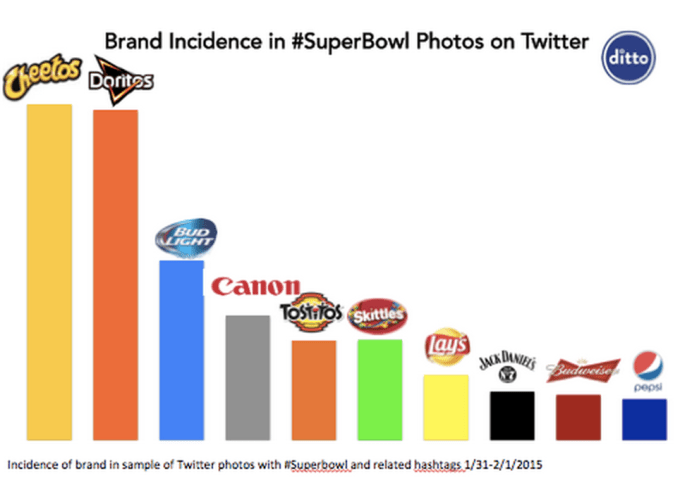
Apparently Super Bowl Fans Really Like Cars And Chips On Social Media

SuperBowl Graph We’ve gotten to the point where pretty much every social media and advertising company has to release its own report about Super Bowl ad trends and effectiveness. One of the more interesting ones was a collaboration between Chute and Ditto. The two startups work on visual content (Chute gives marketers tools for harnessing user-generated content like photos, while Ditto is more focused… Read More